Building sujaldb: An LSM-Tree Storage Engine in Rust
I'm writing my own LSM-tree storage engine in Rust to understand databases and systems programming. First up: the write-ahead log.
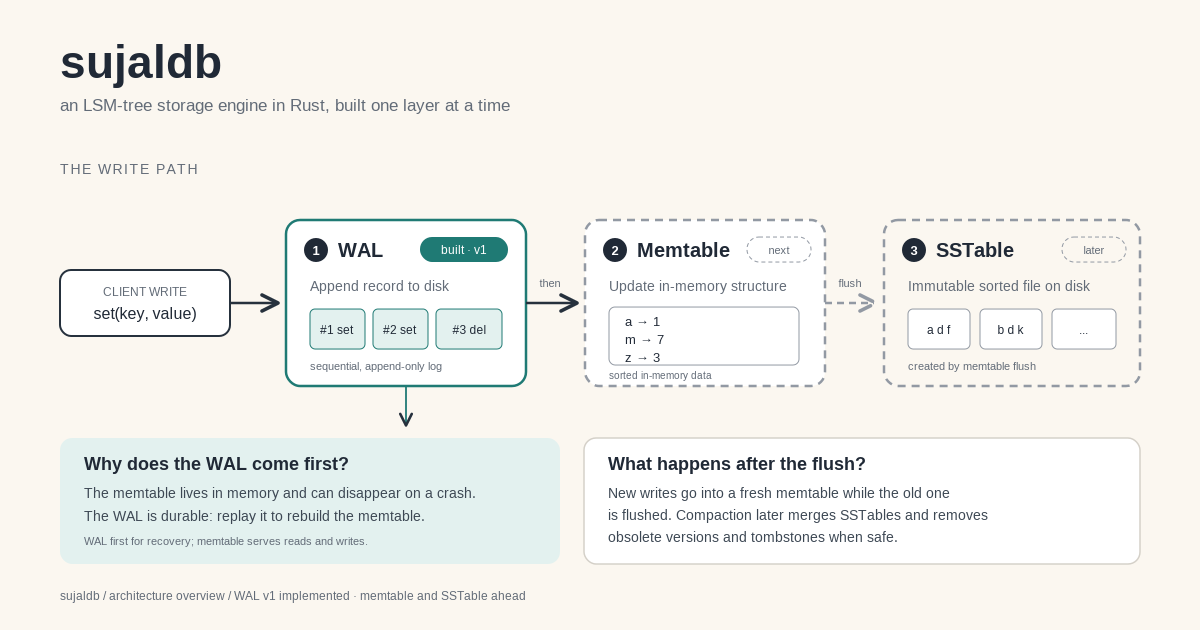
Building my own storage engine in Rust, to understand how databases really work.
A storage engine is the part of a database that writes data to disk and reads it back. Many modern databases, like RocksDB, LevelDB and Cassandra, build theirs on an LSM tree: writes land in memory and an append-only log first, then get flushed to sorted files on disk and merged later.
This post is about where I’ve started: sujaldb, my own LSM-tree-based storage engine, written in Rust.
Why I’m building it
Reading about databases only gets me so far. I want to understand how they really work, so I’m building one.
- Understand how a database stores data and recovers from crashes
- Get comfortable with systems programming in Rust
- Get a real feel for the foundations that distributed databases are built on
Starting with the write-ahead log
I’m starting with the write-ahead log (WAL). Every write is recorded in a log on disk first, so after a crash the engine can rebuild what it had in memory. It’s the layer the rest of the engine leans on, which makes it a good place to learn how a database stays durable.
WAL v1 is done. What it does:
- Append-only: records are only ever added to the end of the file
- Each record holds a sequence number, an operation (set or delete), a key and a value
- CRC32 on every record, so corruption can be detected
- One write call per record
- You choose when to fsync, so durability is a decision rather than a cost on every write
v1 only writes. There’s no reader or replay yet, and no write buffering.
What’s next
v2 of the WAL adds buffering. Right now almost every write is a system call, and buffering will cut that down.
I’m building sujaldb as I go, one layer at a time, and only moving on once I understand the one I’m on. Slow on purpose.